
Suna Yoga
StandingBeginner

Triangle Pose

Trikonasana

Triangle Pose (Trikonasana, meaning "three angle" or "triangle" in Sanskrit) is a classic standing posture that appears across virtually every school of yoga, and for good reason. Reaching the body into a strong lateral stretch, it simultaneously opens the hips and chest, strengthens the legs, and asks the spine to lengthen in two opposing directions at once. This teaches a quality of awareness that carries into all other poses: the ability to find space and length even when the body is working hard. Many teachers consider it essential to master early, as the alignment principles it demands inform nearly every other posture in the practice.
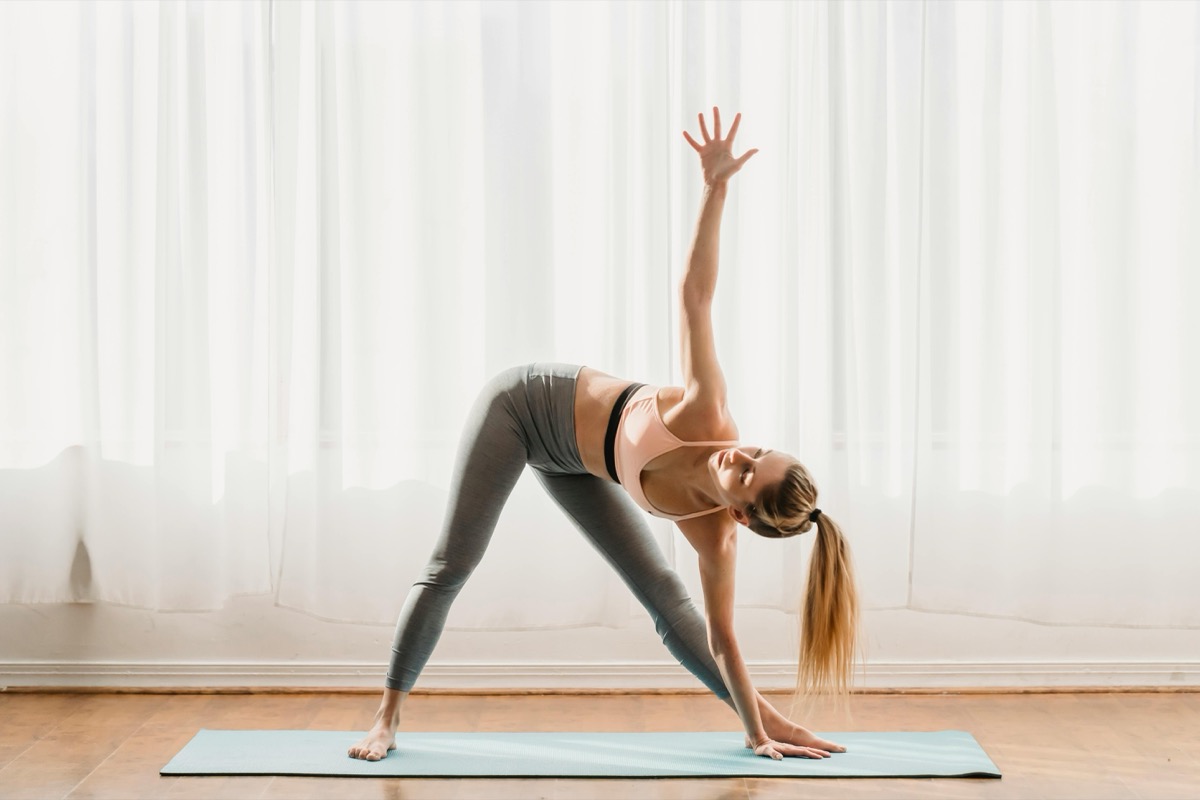
Woman performing Triangle Pose (Trikonasana) in a light-filled room at home

Benefits

  • Stretches and strengthens the thighs, knees, and ankles
  • Opens the hips, groin, hamstrings, and calves
  • Opens the chest and shoulders
  • Relieves stress and anxiety
  • Improves digestion by stimulating abdominal organs

Step-by-Step Instructions

  1. 1

    Stand with feet about a metre apart.

  2. 2

    Turn your right foot out 90 degrees and your left foot in slightly.

  3. 3

    Extend your arms parallel to the floor.

  4. 4

    On an inhale, lengthen your torso over your right leg, hinging from the hip.

  5. 5

    Lower your right hand to your shin, ankle, or a block placed outside the foot.

  6. 6

    Extend your left arm straight up, stacking shoulders.

  7. 7

    Open your chest toward the ceiling and gaze up, forward, or down.

  8. 8

    Hold for 5 breaths, then switch sides.

Common Mistakes to Avoid

  • Rounding the lower back: hinge from the hip, not the waist

  • Pressing the hand too hard into the shin: let it rest lightly

  • Collapsing the top shoulder: keep the chest fully open

Modifications & Variations

  • Place a block under the bottom hand to reduce the range of motion

  • Rest the back body against a wall for alignment feedback

Safety Notes

Neck problems: gaze forward instead of up

Low blood pressure

Headache

Frequently Asked Questions

Should my bottom hand touch the floor in Triangle Pose?
Only if it can do so without collapsing the chest or shortening the side of the body. Many people reach for the floor and in doing so round the shoulder, close the chest, and lose the lateral length that makes the pose effective. A block placed outside the foot at whatever height allows you to keep the chest open and the spine long is far better alignment than a hand on the floor with a crunched upper body. Use the block without any embarrassment; it is there because it improves the pose.
Why does my neck get sore when I look up in Triangle Pose?
Looking up in Triangle asks the neck to rotate while the head is already tilted sideways, which creates compression on the cervical vertebrae, particularly if the neck is tight or the shoulders are not fully open. If it causes discomfort, simply look forward rather than up; this is a completely legitimate variation that removes the neck strain entirely. As your thoracic mobility improves and the chest opens more, looking up will become more comfortable over time.
What is the difference between Triangle Pose and Extended Side Angle?
In Triangle Pose, both legs stay straight, so the stretch comes primarily through the hamstrings and lateral body. In Extended Side Angle, the front knee bends to roughly 90 degrees, which brings the body closer to the ground and shifts more of the work into the hip and groin of the bent leg. Extended Side Angle also requires more shoulder and chest opening to stack the top arm fully. Triangle tends to be the stronger hamstring stretch; Extended Side Angle is a deeper hip and groin opener.

Your Cart

Your cart is empty

Looks like you haven't added anything yet.